mardi 31 janvier 2017

Herman Dooyeweerd: Introduction to a Transcendental Criticism of Philosophic Thought

Willem van Aelst (1627–after 1682)
Introduction to a Transcendental Criticism of Philosophic Thought
by Herman Dooyeweerd 
Evangelical Quarterly XIX (1) Jan 1947

"Let us now compare the theoretic attitude with the pre-theoretic attitude of common experience. The latter is characterised by an absolute lack of all antithetic relation. In the attitude of common experience we find ourselves completely within empirical reality with all the functions of our consciousness. There is no distance, no opposition between the logical aspect of our thought and the non-logical aspects of reality. But if there is an absolute lack of the antithetic relation, naïve [ie common] experience is none the less characterised by another relation, namely the relation of the subject to the object of our experience. Current philosophy has very erroneously confounded this relation with the antithetic relation of theoretical thought. It is precisely the opposite.

"In naïve experience we attribute without hesitation objective qualities – sensory, logical, cultural, social, aesthetic, even moral – to the objects of our common life. We know very well that they cannot function as subjects which feel, distinguish logically, live together in a society, or make value-judgments. We know perfectly that these objective qualities belong to them only with reference to the subjective functions of some possible consciousness. We experience this relation of subject and object as a structural relation of reality itself. That is to say, sensory colour belongs to the rose only with reference to a possible sensory perception, not to my individual perception or yours. To sum up: the subject-object relation leaves reality intact, together. The antithetic relation on the contrary is the product of an analysis, an abstraction."

Download PDF (10 pages)
_________________________
See J Glenn Friesen's 
Dooyeweerd Glossary
_________________________
__________________________________________

J. Glenn Friesen: Dooyeweerd’s Idea of Modalities: The Pivotal 1922 Article

Dooyeweerd’s Idea of Modalities: 
The Pivotal 1922 Article
Abstract
Dooyeweerd says that “the first rudimental conception” of his philosophy had ripened even before he started work at the Kuyper Foundation in October 1922. He had not even studied Kuyper's works, although he would later find some similarities in Kuyper. A detailed analysis of an article written earlier in 1922 shows us how Dooyeweerd developed his philosophy. This article is “Normatieve rechtsleer. Een kritisch-methodologische onderzoeking naar Kelsen's normatieve rechtsbeschouwing.” It includes these ideas: the rejection of the autonomy of thought, the idea of intuitive beholding [schouwen], and the idea of modalities or modes of consciousness. Previous historians of reformational philosophy have not adequately researched Dooyeweerd's sources for these ideas. None of these sources are Calvinistic. Dooyeweerd used these ideas to critique neo-Kantianism. He dismantles Kant's logical categories and instead puts forward the idea of intuited modalities. And Dooyeweerd uses the scholastic idea of ‘meaning moments’ to individuate these modalities from totality.

Keywords
autonomy of thought - Herman Dooyeweerd - intuitive beholding (schouwen) - Kant - modalities - meaning-moment - Emil Lask - neo-Kantianism
Download PDF (33 pages)
_________________________
See J Glenn Friesen's 
Dooyeweerd Glossary
_________________________

mardi 10 janvier 2017

Craig Murray: 'Scotland’s Stolen Seas: The Technical Explanation'


(This video originally published  Sept 2014)
In 1999, the very evening before the devolved Scottish Parliament first opened, the UK establishment reclassified 6,000 square miles of Scottish sea as English waters. 
Scotland’s Stolen Seas: 
The Technical Explanation
by Craig Murray (10 Jan 2016)

I do not think that any work I have done has brought me as much abuse as that on the transfer of 6,000 square miles of Scottish sea to England in 1999, effected by New Labour by Order in Council literally the day before the Scottish Parliament came into being.

Some of this criticism has been utterly bizarre, including a strange contention that the whole thing did not happen and the legislation does not exist. A marginally more rational criticism has been the contention that the new boundary – which at its extreme limit eastwards runs north of Carnoustie – reflects a genuine median line influenced by the shape of the coastline.

With thanks to this map kindly sent by Dave Philip, I wish to explain why the new boundary is not legitimate.

READ FULL ARTICLE
_____________________________

mercredi 4 janvier 2017

UK Supreme Court: Article 50 'Brexit' Appeal (IWGB Submission - Aidan O’Neill QC)

UK Supreme Court: Article 50 'Brexit' Appeal
WRITTEN INTERVENTION FOR THE INDEPENDENT WORKERS UNION OF GREAT BRITAIN (IWGB)
[Interveners (4)]
_________________________________________
PDF of entire document
_________________________________________
1. SUMMARY OF THIS INTERVENTION 
1.1 The IWGB submits that the decision of the Divisional Court was correct in law and that the Appeal should be dismissed. In summary, the IWGB submits as follows: 
(1) This Court, as the constitutional court for the United Kingdom (UK), must take into account the Scottish constitutional tradition in deciding this appeal: Section 2, §§ 2.1-2.6. 
(2) Scottish constitutional law on the prerogative requires this Court to conclude that the UK Government cannot unilaterally give Article 50(2) TEU notification of the UK’s intention to withdraw from the European Union (EU) because it has not (yet) been authorised to do so by the relevant legislatures of the UK: Section 3 §§ 3.1-3.20. 
(3) The Scotland Acts 1998 and 2016 have caused profound change in the balance in and structure of the UK constitution, which must be reflected by this court: Section 4 §§ 4.1-4.15. 
(4) Scottish constitutional law, as understood against the EU principles of respect for democracy and equality of its citizens and the ECHR principles of fairness and legality, requires that any decision to withdraw the UK from the EU has to be made with the consent of all four of the democratically elected legislatures of the UK: Section 15 §§ 5.1-5.10. 
(5) Against this understanding of the constitution, five points are made in conclusion which demonstrate how the Appellant’s claim to rely upon the royal prerogative to give Article 50(2) TEU notification without prior legislative authorisation are untenable: Section 6 §§ 6.1-6.21.
2. SCOTTISH CONSTITUTIONAL LAW AND THE UK CONSTITUTIONAL COURT

2.1 Article 50(1) of the Treaty on the EU (TEU) [1/8] provides that “any Member State may decide to withdraw from the Union in accordance with its own constitutional requirements.” The proper interpretation of Article 50 TEU is a matter for the CJEU, but it is for this court to determine what the UK constitution requires for the Article 50 TEU procedure properly to be invoked.

2.2 Answering that question shines a spotlight on just what the UK constitution is. But UK constitutional law has been the law that dare not speak its name. This is because the 1707 Parliamentary union between England and Scotland undoubtedly created a new State, but it did not create one Nation. Various schemes for a wholly incorporating ‘perfect’ Union of Scotland and England had, unsuccessfully, been proposed to the English Parliament by James VI, King of Scots, after he had acceded to the English throne in 1603. The 1707 Union differed from these earlier schemes in that, while ensuring the depoliticisation of Scotland, it put into place measures intended to protect - and indeed to strengthen - other aspects of Scotland’s distinctive continuing nationhood. Conrad Russell put it thus [505] (internal
footnote added):
“That the Scots found a perfect union politically unacceptable, and the English an imperfect union intellectually incomprehensible, provides the basis for the odd mixture of the two which was set up in 1707. The English got the unitary sovereign power which they wanted, and got it in the form based upon the existing English Parliament, with an English majority in it. The Scots got their recognition as a separate sovereign state, both from the form of the Union of 1707 as an international treaty, and from the survival of Scots law and the Scottish church. It is that claim that Scotland is a sovereign nation state which is reasserted whenever the English forget that 1707 was not a ‘perfect union’ and has recently been repeated in the Claim of Right. Scotland in accepting the Union in 1707 remained a nation and as a result any sovereignty in the British parliament could not be national sovereignty. This has always been hard for the English to understand.”
2.3 In the 300 years of that 1707 Union, there is no doubt that that the English constitutional tradition has been the dominant and, at times, overwhelming influence; but a distinct Scottish constitutional tradition has never entirely been lost and may, indeed, be said to have been revived by the devolutionary settlement for Scotland. Dicey and Bagehot, Coke and Blackstone may well be reliable guides to the English constitutional tradition, but their views are not necessarily determinative or reflective of what the UK constitution now is. Like the English common law, the Scots constitutional tradition is not an ossuary.

 One thing is clear, however. When the UK Supreme Court has to speak of UK Constitutional law it enters into perilous waters because the two constitutional narratives and traditions to which the UK is heir - the English historical myth emphasizing the sovereignty of the governing institutions of the State (the Crown, and the Crown in Parliament) and an unbroken continuity since Magna Carta in 1215 CEand the Scottish tradition, since at least the Declaration of Arbroath of 1320 CE [19/210], of the sovereignty of the people limiting the powers and rights of the Crown (and Parliaments) – may pull in different directions, but yet have to be reconciled if this union polity is to survive.

2.4 Notwithstanding that this matter comes here on appeal from the Divisional Court of England and Wales, this Court is not here faced with matters of purely English law. This Court is determining matters concerning the content and extent of the constitutional obligations imposed on all institutions of the now democratically based British (and Northern Irish) State, its Parliaments as much as its courts and Governments, to show respect for those fundamental constitutional norms inherent in a democratic polity. Accordingly, the role of this Court is to be conscious of and take due account of these various narratives and sources for our multiply texted constitution, as was essayed in R (Buckinghamshire County Council) v Secretary of State for Transport [2014] UKSC 3 (HS2) [7/56] per Lord Neuberger and Lord Mance at §207 (emphasis added):
“The United Kingdom has no written constitution, but we have a number of constitutional instruments. They include Magna Carta, the Petition of Right 1628, the Bill of Rights and (in Scotland) the Claim of Right Act 1689, the Act of Settlement 1701 and the Act of Union 1707. The European Communities Act 1972, the Human Rights Act 1998 and the Constitutional Reform Act 2005 may now be added to this list. The common law itself also recognises certain principles as fundamental to the rule of law.”
2.5 The Divisional Court below, guided no doubt by the limited submissions made to it by the parties and interveners, referred only to the (English) Bill of Rights of 1688 [12/106]. Article 9 of the English Bill of Rights - which enjoins “that the Freedom of Speech and Debates or Proceedings in Parliament ought not to be impeached or questioned in any Court or Place out of Parliament” - is cited and relied upon by the courts in Scotland as well as England, so it undoubtedly forms part of the UK constitution. But the (Scottish) Claim of Right of 1689 is equally a constitutional instrument for and within the UK. It is, after all, on the basis of the Claim of Right’s assertion “that it is the right and privilege of the subjects to protest for remeed of law to the King and Parliament against Sentences pronounced by the lords of Session” that this Court exercises its jurisdiction to hear appeals from the Court of Session.

2.6 Accordingly, the actions of the UK Government today can properly be measured and declared to be unlawful to the extent of its incompatibility with this Scottish constitutional tradition, on the basis that the Union preserves both constitutional traditions, and that the rule of law favours that tradition which offers the stronger protection for individual rights.

3. THE SCOTTISH CONSTITUTIONAL TRADITION: THE CROWN LIMITED BY POPULAR SOVEREIGNTY

Tracing the history of Scottish constitutional law: sovereignty resides in the people

3.1 The Scottish constitutional theory of the power of the Crown being received from the people and limited by the law was first systematically set out by George Buchanan (1506 CE - 1582 CE), the celebrated European humanist scholar and poet, citizen of the Republic of Letters, historian of Scotland, tutor to the young James VI and constitutionalist who, in his dialogue De iure regni apud Scotos (1567) noted, among other things, that in Scotland
 “the people who have granted the king authority over themselves dictate to him the extent of his authority, and require him to exercise as a king only such right as the people have granted him over them”; and  
“the power received by our kings from our ancestors was not unbounded but was limited and restricted within fixed boundaries”; and  
“if the greater part of the people can pass a law and elect a magistrate, what is to prevent them judging the magistrate themselves or appointing judges to try him... Why should it seem unjust to any man if a free people have provided themselves in a similar or even in a different way with the means of restraining the harshness of tyranny.”
3.2 According to George Buchanan, therefore, the law and customs and immemorial constitutional tradition of the Scots in relation to the Crown is one of a limited constitutional monarchy involving:

(i) subordination of the Crown to the law;

(ii) the Crown’s answerability before the courts; and

(iii) in the last resort, the people’s right of revolt against a monarch in fundamental breach of his or her duties.

3.3 In the 1644 CE work of the Scottish Presbyterian Divine Samuel Rutherford (c.1600 CE–1661 CE) Lex Rex [27/344], Rutherford answers his Question XLIII on “whether the King of Scotland be an absolute prince, having prerogatives above Parliament and laws: the negative is asserted by the laws of Scotland, the King’s oath of coronation, the Confession of Faith etc.” as follows: 
“The kings of Scotland have not any prerogative distinct from supremacy above the laws. If the people must be governed by no laws but by the king's own laws, that is, the laws and statutes of the realm, acted in parliament under pain of disobedience, then must the king govern by no other laws, and so by no prerogative above law… [I]n treaties with foreign princes, the estates of parliament did append their several seals with the king's great seal, (which to Grotius, Barclaius, and Arnisæus, is an undeniable argument of a limited prince, as well as the style of our parliament, that the estates, with the king, ordain, ratify, rescind, &c.) as also they were obliged, in case of the king's breaking these treaties, to resist him therein, even by arms, and that without any breach of their allegiance, as is yet extant in the records of our old treaties with England and France, &c.”
3.4 This position is confirmed in the 1703 Act of the Scottish Parliament anent Peace and War: 
“Our sovereign lady, with advice and consent of the estates of parliament, statutes, enacts and declares that after her majesty's decease, and failing heirs of her body, no person being king or queen of Scotland and England shall have the sole power of making war with any prince, potentate or state whatsoever without consent of parliament, and that no declaration of war without consent foresaid shall be binding on the subjects of this kingdom, declaring always that this shall no way be understood to impede the sovereign of this kingdom to call furth, command and employ the subjects thereof to suppress any insurrection within the kingdom or reject any invasion from abroad according to former laws; and also declaring that everything which relates to treaties of peace, alliance and commerce is left to the wisdom of the sovereign, with consent of the estates of parliament who shall declare the war. And her majesty, with consent foresaid, rejects, casses and annuls all former acts of parliament in so far as they are inconsistent herewith or contrary hereunto.” (emphasis added)
3.5 In “The Crown Rights of the Redeemer: the Chalmers Lectures of 2007”, the Reverend Dr. Marjory MacLean summarises this Scottish constitutional tradition of popular sovereignty as follows: 

“Turning from the question of what defines sovereignty to the question of what its source is, we find that the characteristically Scottish Reformed approach developed through the thinking of John Knox, George Buchanan, Samuel Rutherford and the framers of the National Covenant of 1638. There are several elements in this Scottish tradition. First, at its root is a belief in popular sovereignty, by which is normally understood the self-determination of the whole people in the context of their relationship (individual and corporate) with God. In the immediate post-Reformation literature it is difficult to find a clear description of how an articulate and identifiable process of self-determination works, though the process of bonding or banding brought together people of like minds into groups strong enough to effect political and constitutional change.

The second element in the Scottish model is ‘fiduciary dominion’, the ruler’s power (dominium) to govern given by the people, who offer their trust (fides) but not their sovereignty, which according to the theory remains with them. The ruling power is therefore supreme but constitutionally bound, and cannot arbitrarily change the bounds of its authority or the constraints under which it is obliged to operate.

The third element of the Scottish model is the presence of such constraints on the sovereign people and the holder of fiduciary dominion alike: these have normally been Natural Law and Divine Law, as understood from time to time, and the rule of law.”

3.6 This tradition of popular sovereignty within the Scottish constitution reached its apotheosis with the decision by the self-convened Scottish Parliament in 1689 to declare James VII to have forfeited the Crown on the basis of its claims that he had over-reached the lawful limits placed on his executive power. The use of the word ‘forfeited’ was of particular significance because it was consistent with the terms of the 1320 CE Declaration of Arbroath [19/210] as well as with the constitutional writings of George Buchanan and Samuel Rutherford.

3.7 The Bill of Rights 1688 [12/106] declares that “the pretended Power of Suspending of Laws or the Execution of Laws by Regal Authority without Consent of Parliament is illegal”. This is echoed in the Claim of Right’s declaration [19/211] that “That all Proclamations asserting an absolute power to Cass [anglice Quash] annul and Disable laws… are contrary to Law”. But the Scottish constitutional tradition of popular sovereignty which the Claim of Right 1689 was articulating may be contrasted with the (English) Bill of Rights tradition where, as Conrad Russell notes, the prevailing “theory of legitimacy” was one “where authority, however much it might feel the need for consent, was ultimately descending”Accordingly, rather than speaking of the king being deposed in the Glorious Revolution, the English Bill of Rights employed the legal fiction that the king, in fleeing to France, had chosen to “abdicate” his throne, thereby preserving the fiction that the existing constitutional order in England continued. The English Declaration and Bill of Rights 1688 are also to be contrasted with the Scottish Claim of Right 1689 in that the English document makes no reference to James II’s oath on entering government that he will “rule the people according to the laudable laws”. Nor does the English document claim that James II had expressly breached any of the terms of his (English Coronation) oath. And the English document similarly makes no reference - unlike the Scottish text - to James II and VII invading the “fundamental Constitution of the Kingdom” and of that constitution properly being understood as a “legally limited monarchy”. Nor do the English, in terms, accuse the James II of attempting to subvert the constitution that he was in office to uphold, complaining instead only of specific acts of “arbitrary power” (namely “prosecutions in the Court of King’s Bench for Matters and Causes cognizable only in Parliament and by diverse other Arbitrary and Illegal Courses”), rather than the root and branch corruption of power which the Scottish Claim of Right of 1689 had identified. 

3.8 In this early modern period, models of constitutional government are expressed in the terms of political theology. The religious is political precisely because in defining the terms of the Church settlement in a territory you define the source and extent of power of the State.19 So in Scotland at least, the term “Papist” translates into a believer in absolutist government; “Episcopalian” into a supporter of constitutionally limited Monarchy; while “Presbyterians” hold to a democratic model in which the Elect(ors) delegate defined and limited powers to those whom they appoint to hold office.

3.9 The whole point about the 1707 Union is that it constitutionally entrenched the distinct Scottish and English constitutional traditions as embodied in the two nations’ separate ecclesiastical settlements. Thus, the “securing of the Protestant Religion and Presbyterian Church Government within the Kingdom of Scotland” was expressly declared to be “a fundamental and essential Condition of the said Treaty or Union in all times coming.” And it was similarly declared by the English Parliament that the preservation of the Anglican settlement in England also be made “a Fundamental and Essential part of any Treaty of Union” with Scotland. And this is not simple antiquarianism or misplaced originalism. The accession oath which was sworn by Elizabeth II before the Accession Privy Council on the day immediately after her accession, and which is renewed by her each year (whether in writing or in person) before the General Assembly of the Church of Scotland is in the following terms:
“I, Elizabeth the Second by the Grace of God of Great Britain, Ireland and the British dominions beyond the seas, Queen, Defender of the Faith, do faithfully promise and swear that I shall inviolably maintain and preserve the Settlement of the True Protestant Religion as established by the laws of Scotland in prosecution of the Claim of Right and particularly an Act entitled an Act for the Securing the Protestant Religion and Presbyterian Church Government and by the Acts passed in both Kingdoms for the Union of the two Kingdoms, together with the Government, Worship, Discipline, Rights and Privileges of the Church of Scotland. So help me God.” (emphasis added)
3.10 What this means is that this distinctive Scottish constitutional tradition embodied in the Claim of Right - of the Crown holding power from and in trust for the people assembled “in a full and free representative of this Nation”, with the Crown bound by the constitution to honour the terms and limits of the sovereign people’s grant of that power, and with both the people and the Crown subject to a duty to respect fundamental rights and the rule of law - not only survived the 1707 Union, but was expressly preserved by it and is reaffirmed by the Crown in personam every year of her reign.

3.11 This Scottish constitutional tradition of popular sovereignty has most recently been restated and confirmed by the UK Parliament in the terms in Section 1 of the Scotland Act 2016 which inserts a new Section 63A to the Scotland Act 1998 (SA) [12/124] in the following terms:

63A Permanence of the Scottish Parliament and Scottish Government

(1) The Scottish Parliament and the Scottish Government are a permanent part of the United Kingdom's constitutional arrangements.

(2) The purpose of this section is, with due regard to the other provisions of this Act, to signify the commitment of the Parliament and Government of the United Kingdom to the Scottish Parliament and the Scottish Government.

(3) In view of that commitment it is declared that the Scottish Parliament and the Scottish Government are not to be abolished except on the basis of a decision of the people of Scotland voting in a referendum.” (emphasis added).

3.12 The reference in Section 63A(3) SA to the maintenance/abolition of the Scottish devolved institutions of Government, being a matter for “a decision of the people of Scotland” - rather than simply saying “on the basis of a referendum held in Scotland” - only makes sense (since there is otherwise no specification in the Scotland Act as to who constitutes “the people of Scotland”) as a clear and unequivocal reference to, and affirmation by the Westminster Parliament of, this Scottish constitutional tradition of popular sovereignty.

No harmonisation of Scottish constitutional law on the Crown and prerogative post-Union

3.13 Although Article XVIII of the 1707 Union allowed that “Laws which concern public Right Policy and Civil Government may be made the same throughout the whole United Kingdom… by the Parliament of Great Britain”, the Union did not, in fact, result in the harmonisation - and still less in the assimilation - of public law in Scotland with that of England. In 1758 Lord Mansfield ruled in King v Cowle 97 ER 587[483]:

“1st. That this Court has no jurisdiction over the town and borough of Berwick, or any local matters arising there; because it is not to be deemed part of the realm of England, and the King's writ does not run there: consequently, this Court has no authority to remove a record from thence, by writ of certiorari, for any purpose…

Writs, not ministerially directed, (sometimes called prerogative writs, because they are supposed to issue on the part of the King,) such as writs of mandamus, prohibition, habeas corpus, certiorari, are restrained by no [856] clause in the constitution given to Berwick: upon a proper case, they may issue to every dominion of the Crown of England. There is no doubt as to the power of this Court; where the place is under the subjection of the Crown of England; the only question is, as to the propriety.

To foreign dominions, which belong to a prince who succeeds to the throne of England, this Court has no power to send any writ of any kind. We cannot send a habeas corpus to Scotland, or to the electorate [of Hanover]: but to Ireland, the Isle of Man, the plantations, and, as since the loss of the Duchy of Normandy, they have been considered as annexed to the Crown, in some respects, to Guernsey and Jersey, we may; and formerly, it lay to Calais; which was a conquest, and yielded to the Crown of England by the treaty of Bretigny”. (emphasis added).

3.14 As one commentator has noted in this regard [502]:

“The reason, therefore, why Scotland is exempt from this jurisdiction [of habeas corpus] is, that it extends only over the dominions which prior to the Union were dominions of the crown of England, and Scotland was never part of the dominions of the crown of England. The King of Scotland came also to be King of England, but this did not make Scotland subject to the crown of England.” (emphasis added) 
ETC.
_________________________________________
PDF of entire document
_________________________________________

jeudi 8 décembre 2016

DOCUMENTARY: 'LONDON CALLING: BBC bias during the 2014 Scottish independence referendum'


LONDON CALLING:
BBC coverage bias during 2014 Scottish Referendum  (1hr 9mins)
______________________________________
Read the book behind the film
online FREE...

'London Calling: How the BBC stole the Referendum' by G.A.Ponsonby is the original book which inspired the above documentary. It is a major exposé of BBC Scotland's political news manipulation. It is generously illustrated with screenshots of BBC webpage imagery and headline manipulation. The book chronicles in compelling detail copious examples of flagrant bias in the influential broadcaster's coverage of Scottish politics and of the 2014 independence referendum in particular. 
For chapter headings go

Also on Kindle for £1.99
______________________

lundi 5 décembre 2016

Dooyeweerd: Does historic humanist dichotomy give insight on Brexit, Trump, Euro-Right?

Dooyeweerd: Does Historic Humanist Dichotomy Give Insight on Brexit, Trump, Euro-Right?
Historical Humanist Dichotomy
"The deepest root of its dialectical character lies in the ambiguity of the Humanistic freedom-motive. The latter is the central driving force of the modern religion of human personality. And from its own depths it calls forth the motive to dominate nature, and thus leads to a religion of autonomous objective science in which there is no room for the free personality." (Herman Dooyeweerd, New Critique of Theoretical Thought)
The late Dutch thinker Herman Dooyeweerd lived through the Nazi occupation. The Dooyeweerd family sheltered JewsAfter the war Dooyeweerd wrote a long series of newspaper articles which were eventually published as the Dutch original of the book: 'Roots of Western Culture: Pagan, Secular and Christian Options'

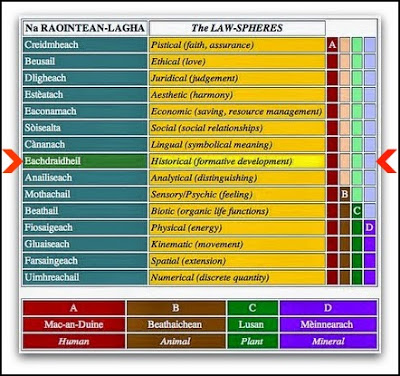
In part of the book Dooyeweerd philosophically plumbs the origins of German fascism. There are various elements to this, but the strand to note here refers to the corrosive influence of "historicism": Classical Humanism (circum French Revolution) had posited rationalist (Natural Mechanistic Law) absolutes which over-arched time. By the early 20th C, in the wake of Romanticism, an irrationalist (Lawless Personal Freedom) counter-polarity of humanism was taking over. Absolutization of the Historical Aspect (see Chart of Aspects below) began sucking everything into an existential maelstrom. 
Historical Aspect (Law-Sphere)
There were now NO absolutes spanning time. Norms were only provisional - a fleeting consensus within a universal flux:
"It calls itself dynamic, believing that all of reality moves and unfolds historically. It directs its polemic against static views that adhere to fixed truths. It considers reality one-sidedly in the light of historical becoming and development, arguing that everything is purely historical in character. This 'historicism', as it is called, knows of no eternal values. All of life is caught up in the stream of historical development. From this point of view the truths of the Christian faith are just as relative and transient as the ideals of the French Revolution [...]  
"Following the example of the mathematical and natural sciences, earlier humanistic theory had always sought after the universally valid laws that control reality. It constructed an 'eternal order of natural law' out of the 'rational nature of humankind'. This order was totally independent of historical development, and was valid for every nation at all times and in all places. The earlier rationalistic humanism displayed little awareness of the individual traits of peoples and nations. All individual things were regarded as mere instances or examples of a universal rule and were reduced to a universal order. This reduction highlights the rationalistic tendency of this type of humanistic thought.  
"But as a result of the polarity of its religious ground-motive, humanism veered to the other extreme after the French Revolution. Rationalistic humanism turned into irrationalistic humanism, which rejected all universally valid laws and order. It elevated individual potential to the status of law. Irrationalistic humanism was not inspired by the exact mathematical and natural sciences but by art and the science of history. Art revealed the 'genius' and uniqueness of individuality. This 'romanticism', which for a time dominated western culture during the Restoration period after Napoleon's fall, was the source of the view of reality defended by the Historical School." (Herman Dooyeweerd, 'Roots of Western Culture' pp 43, 50)
But Communism resisted this. It still subscribed to time-transcending laws:
"It should not be forgotten that communism in its Marxian and Bolshevist sense is primarily a spiritual power, a secularized eschatological faith in the final liberation of mankind in a future classless society" (Dooyeweerd, 'A New Critique of Theoretical Thought' Vol 4 p 602).
Finally, getting to our main point, German Fascism also (goose-) stepped out of the flux. Nazism recognized no laws above itself EXCEPT the genius and destiny of the German volk. This also involved the secularization of a Christian motif:
"When the Historical School attempted to understand the whole of culture, language, art, jurisprudence, and the economic and social orders in terms of the historical development of an individual national spirit, it elevated the national character to the status of the origin of all order. It therefore denied the truth that the individual creature always remains subject to law. It argued that if the individual potential of a man or nation is the only law for development and action, then this potential cannot be evaluated in terms of a universally valid law. Accordingly, any nation was considered to act rightly and legitimately if it simply followed the historical fate or goal implicit in its individual potential or disposition.  
"This view of reality was historicistic in the sense explained above. Although the Historical School fundamentally rejected the validity of general laws, it nevertheless tried to compensate for this by seeking to reach a kind of compromise with the Christian belief in 'divine providence'. It proclaimed divine providence to be a 'hidden' law of history, arguing that God's providence rules the history of a nation. As the Christian mask was laid aside, 'providence' was replaced by Schicksal, the historical destiny or fate of a nation. Schicksal played the same role as divine providence; it operated as a norm for the development of a national character.  
"Careful readers will have noted how closely this view approaches the spiritual atmosphere of national socialism and its appeal to providence, to the 'Destiny of the German People'  [Schicksal des deutschen Volkes]. We will do well to keep the affinity between national socialism and the Historical School in mind, for later we will see that nazism must be considered primarily a degenerate fruit of the historicism propagated by the Historical School." (Dooyeweerd, 'Roots of Western Culture' p 52)
Plausible connections to the social dynamics leading to Brexit, to Donald Trump, and to what is happening more widely in European politics, seem not so difficult to make. The crumbling of so many social pillars leave people psychologically vulnerable. They face an increasing overload of choices. The security of tradition and the relief of everyday routine diminish. There is a stalling of national and international direction.

Laws seem politicised and arbitrary. Authoritarian so-called 'progressive' governments marginalise and indeed criminalise 'traditional' views, cynically intimidating the populace into a silence which is then hailed as endorsement. The elite mantra is relentlessly megaphoned by radio, television, and cinema: The need to be "on the right side of history" is absolute. The youth by and large become true believers. The mortality of recalcitrant older folk is (how can it be delicately phrased?) not a matter of deepest regret.

 The Ships of State pitch as the oceans heave. Captains are sought who promise at least some return to stability.... 
See also:

----
----
----
----
----
---- 
'Sphere-sovereignty', 'sphere-universality', Christian responsibility to join the struggle of historical 'opening-process' - 
---- 
Website of pages on Dooyeweerd's identification of the normative parameters of the State, 
ie 'territorial power' and 'pursuit of justice' - 
___________________________________

mercredi 30 novembre 2016

Dooyeweerd: Hume, Kant, The Unfathomable Silence of the Sphinx, Soap-bubble Reality...


THE 15 IRREDUCIBLE LAW-SPHERES 
OF OUR EXPERIENTIAL HORIZON 
Also called Aspects/ Modes/ Modalities/ Meaning-sides
(Diagrams by FMF)

NOTES (FMF):
No law-sphere (aspect) can be reduced to another. Infringements of 'irreducibility' are behind all 'isms'. These 'idolatries' show the human heart attempting to integrate entire reality around a single aspect (or 'law-sphere'). There is a plausibility to this because each aspect is present as an analogy in every other aspect (see 'Historical Aspect' diagram below). This gives each aspect an omnipresence, which Dooyeweerd designates 'sphere-universality'. 

Crucially, since no aspect can be reduced to another, none can be reduced even to the 'Logical / Analytical Aspect' (in other words, the above panoply of aspects is not a theoretical product of "logic" - it is "experiential", it is "intuitive consciousness"). This must be particularly and continually emphasised. Failure to bear that specific fact in mind makes a 'logicism' out of Dooyeweerd's philosophy, when it is primarily against logicism that he is arguing (Dooyeweerd's 'A New Critique of Theoretical Thought' is essentially a critique of Kant). A moment's reflection will observe that the aspects correspond pretty closely to standard academic disciplines.

It is key to Dooyeweerd to appreciate his insistence that there is no thinking without a thinker ("the hidden performer on the instrument of philosophic thought" (Prolegomena, New Critique). The thinker ALWAYS functions in ALL aspects, but transcends them all in the concentration-point of his or her deepest selfhood ('heart'), which is directed towards or away from the Living God Who alone gives meaning to temporal reality. In refusing God as only source of meaning, a substitute ultimate focus is sought by the selfhood within the temporal cosmos by absolutising a law-sphere (or combination of law-spheres). Hence the idol.

Dooyeweerd calls the irreducibility feature of each aspect 'sphere-sovereignty'. With reference to mutual irreducibility, Dooyeweerd draws attention to Genesis 1 where animals are created "according to their kinds"Without getting a handle on the terms 'sphere-sovereignty' and 'sphere-universality' it will be impossible to fathom Dooyeweerd's explanations on just about anything!   

Interestingly, the absolutization of any given aspect of reality invariably throws up its 'counter-idol', leading to a dualism. Something like an after-image. The counter-absolute arises as the 'Economic Aspect' of reality resists unbridled profligacy in one direction, the 'Aesthetic Aspect' resists the consequent disharmony, the 'Juridical Aspect' (eventually) avenges the destructive bias via a swing towards the counter-polarity.

Examples:
Rationalism 'deifies' the 'Logical/ Analytical Aspect'. It infringes the irreducibility of the other fourteen aspects by attempting to reduce them all to the 'Logical/ Analytical Aspect'. That is, Rationalism implies that every other aspect is a product of the absolutized 'Logical/ Analytical Aspect' (cf Kant). 

Philosophical Materialism 'deifies' the 'Physical/ Energy Aspect'. It infringes the irreducibility of the other fourteen aspects by attempting to reduce them all to 'matter', ie to the 'Physical/ Energy Aspect'. That is, Philosophical Materialism implies that every other aspect is a product of the absolutized 'Physical/ Energy Aspect'.

Combinations of the above have provoked the prevailing (humanist) 'Nature/ Freedom' dichotomy, ie that between 'Absolute Mathematical (or Natural-mechanistic) Law' and 'Absolute Personal Freedom'. The irreconcilable conflicts of this dualism are perenially revisited in movies and TV series such as the Terminator, the Matrix, Battlestar Galactica, etc. 

Postmodernism is another irrationalist (subjectivist) reaction to the 'rationalism' of reducing reality to 'One Big Story' dogmatically layed down by autonomous human thought. Many films now interrogate reality from a postmodern viewpoint, eg 'Inception', 'Sourcecode', various Tarantino movies, etc.

Christians often labour under their own 'Nature/Grace' dualisms which lead for example to a gnostic or pietistic flight from the world.

-------------
"It is an undeniable fact that in the first life-phase of a suckling baby feeling precedes the first development of logical distinction; the latter precedes the controlling manner of forming sounds, which in turn precedes the primitive symbolical designation of concepts by words etc. But that does not prove that the higher mental functions originate from feeling as their undifferentiated origin. Rather it testifies to the truth of our view of the order of the modal aspects of experience, as a real temporal order, related to subjective duration in the genetic process." (Herman Dooyeweerd, A New Critique of Theoretical Thought Vol II pp 112,113)
__________________________________________
 The above diagram focuses on the 'Historical/Culturally Formative Aspect'Besides its own irreducible (supratemporal) nucleus, its structure includes anticipatory (here in green) or retrocipatory (blue) analogical moments dynamically relating to the other fourteen aspects. The weighting of blues to greens in any given aspect depends on where that aspect appears in the fixed temporal order (compare colour sequence in a rainbow).

Thus (now considering all aspects, not just the Historical), in our everyday lives a 'feeling of claustrophobia' might be analysed as a 'Spatial' retrocipation within the 'Sensory (or Psychical) Aspect'. A 'prolix speech' as an 'Economic' anticipation within the 'Lingual Aspect'. An 'elegant stumble' would be an 'Aesthetic' anticipation within the 'Movement/Kinetic Aspect'. A 'vital clue' a 'Biotic' retrocipation within the 'Logical/Analytical Aspect'. And so on.

It should always be borne in mind that, however inadequate the above diagram, what is being referred to is the fabric of actual cosmic reality within which all aspects structurally combine, as spectrum colours combine to form clear daylight. 

Dooyeweerd sees the Divine call of civilization as a historical “opening-process”. Each succeeding aspect is "unfolded” in response to the light of God. Reactionary societies attempt to close down such burgeoning differentiation.

EVERY human ACT in thought or deed 
ALWAYS involves ALL aspects.

"Keep your heart with all diligence, 
for out of it are the issues of life." 
(Prov 4:23)
________________________________________

Excerpted from: A NEW CRITIQUE OF THEORETICAL THOUGHT
VOLUME II, CHAPTER IV

§ 1 - THE UNIVERSALITY OF THE MODAL ASPECTS WITHIN THEIR OWN SPHERES
The sphere-sovereignty of the modal aspects of reality has its counterpart in the universality of each aspect within its own sphere.

The term 'sphere-universality' is intended to signify that the modal meaning-structure in each aspect gives expression to the entire coherence of meaning of all the law-spheres.

This is made possible by the retrocipations and anticipations in each meaning-modus. Immanence philosophy could not help misinterpreting this state of affairs, because of its failure to grasp this universality in relation to the modal sphere-sovereignty.

Why the different attempts at absolutizing seem to be acceptable.
The universality of each modal aspect within its own sphere may also explain the apparent success of the various absolutizations in immanence philosophy.

Hume's 'Sensory / Psychical Aspect' reductionism.
DAVID HUME, e.g., resolves the whole of given reality in impressions of feeling, or 'perceptions'. He calls out: 'Let us chase our imagination to the heavens, or to the utmost limits of the universe; we never... can conceive any kind of existence, but those perceptions... This is the universe of the imagination' (A Treatise of Human Nature I, Part II, Sect. VI. Italics are mine). In this exclamation we distinctly hear his conviction that he has discovered an undeniable state of affairs.

And indeed, whatever the critical transcendental philosophy might have to say against HUME, the thesis that in 'feeling' the universe expresses itself in the whole of the cosmic meaning-coherence is irrefutable. The analysis of the meaning-structure of the law-sphere of feeling in the retrocipatory and in the anticipatory direction of time confirms the universality of this meaning-modus in every respect.

This structural analysis of the psychical modality does full justice to the kernel of truth in HUME's psychologistic conception. At the same time it lays bare the fundamental error of his psychologistic absolutization, whereas the Kantian epistemological criticism touches the root of this absolutization so little that it becomes itself guilty of absolutizing the transcendental-logical structure of thought.

The universality of the modal meaning of feeling implies that the psychical law-sphere is not self-sufficient. This universality is only possible as a modal universality of the aspect within its own sphere. Its absolutization is equal to its theoretical cancellation.

Therefore, HUME's epistemological psychologism destroys itself if it is consistently thought out. The epistemological thesis that the whole universe is given us only in psychic 'perceptions' cannot be correct. For nothing is given in theoretical abstraction.

The modal meaning of feeling itself cannot be given "an sich" (in itself), i.e. apart from the cosmic meaning-coherence in which it can function only as psychical modus.

Psychologism may try to escape from the force of this argument by answering that here we are exclusively concerned with the problem whether or not we can be aware of anything outside our impressions of feeling. But the opinion that we are at least only conscious of our psychical perceptions, is equal to the denial of any possibility of being conscious of anything. This view results in a radical kind of epistemological nihilism. Being conscious of one's impressions of feeling implies the self-consciousness of the whole of the cosmic meaning-coherence. In this coherence, feeling only exists as a modal meaning-function that lacks self-sufficiency.

Kant's 'Logical / Analytical Aspect' reductionism.
The appeal to a supposed absolute subjective pole of thought in the transcendental cogito cannot hit the heart of psychologism. In the Prolegomena we have disclosed the speculative trap in the conception of the self-sufficiency of the transcendental-logical function of thought. At bottom this self-sufficiency is open to the same criticism as the psychologistic view. A genuinely transcendental epistemological criticism necessarily reveals the self-insufficiency of the transcendental-logical function of thinking, both in theoretical self-reflection and with regard to the temporal intermodal coherence between the experiential aspects. This coherence only makes transcendental logical thought possible. [Or perhaps better: 'Only this coherence makes transcendental logical thought possible.' ?? FMF]

The really radical criticism of the conception of the "Unbedingtheit" (absoluteness, unlimitedness, being unconditioned) of transcendental logical thought is the analysis of the structure of its universality of meaning within its own sphere. Such an analysis also explains the seeming plausibility of the transcendental-logicistic conception. But more about this later on.

In the same way we can show the fundamental error of historicism, aestheticism, mathematicism, biologism, etc., viz. by a structural analysis of the universality of each of the law-spheres absolutized by them.

The Divine irony in the history of apostate philosophy.
The universality of each of the law-spheres within its own boundaries can only be seen in its true structure from the Christian transcendence-standpoint.

Immanence-philosophy continually goes astray, because in its Archimedean point lurks a primary absolutization of meaning.This absolutization is due to a misinterpretation of the universality of each law-sphere within its own limits. There is a Divine irony in the development of apostate philosophy, since the temporal world-order at first seems to justify every kind of theoretical absolutization in an equal measure. When viewed from the immanence-standpoint, is not historicism as convincing as a logicistic or a psychologistical interpretation of empirical reality? Is not it an indisputable fact that in theoretical thought as well as in the life of human feeling is revealed the prevailing tendency of a special period of history? Is it not true that HUME's psychologism as well as KANT's transcendental philosophy bear the stamp of modern western culture? 

HUME asserts that the universe is given to us only in psychical impressions. Wherever we direct our gaze we are supposed to find nothing but 'perceptions'. But cannot this music be transposed with equal justice into the key of the historical aspect? 

HUME thinks he can start from some permanent uniformity of human nature. He places his epistemology outside the current of historical development. Is this not a false dogmatism when confronted with the indisputable universality of the course of historical development?

Indeed, historicism cannot be dethroned solely with formally-logical arguments, no more than transcendental psychologism will capitulate to a logicistical transcendental philosophy.

Only the insight into the universality of the historical aspect within its own sphere reveals the fundamental error of historicism and the grounds for its seeming plausibility.

The cosmic order passes an internal judgment on the theoretical absolutizations of immanence-philosophy, which invariably result in internal antinomies. We cannot interpret the Divine order on the basis of a self-sufficient and autonomous reason. Apart from the Divine Word-revelation, this order maintains the unfathomable silence of the Sphinx.

So long as pistis (faith) remains closed to this Word-revelation, theoretical thought remains under the ban of mythology. The Divine world-order begins to appeal to us only when our heart and our function of faith are open to the voice of God's Word. Then we become aware of the religious foundation of that wonderful universality of each of the modal aspects. For only in the disclosed insight into this profound state of affairs does the Christian see the true connection between temporal reality and the Christian religion in the theoretical cognitive attitude. In the pre-theoretic attitude of thought s/he ought to experience this relation immediately in faith apart from any theory. 

Anyone who, as a Christian thinker, has seen through the modal sphere-universality, cannot fall back into the nominalistic dualism between believing and thinking, and between 'nature' and 'grace'. Every dualism of this kind makes the temporal modal functions self-sufficient with regard to their religious root. But there is nothing in time that can be set apart and by itself.

The Idea of the universality of each aspect within its own sphere should be related to the process of disclosure in the temporal cosmic meaning-coherence in order to reveal its full import.

The new problem: The intermodal disharmony in the opening-process.
But at this very point Christian philosophy is once again confronted with the problem concerning the influence of sin on this process. If it were permissible for a Christian to choose a purely eschatological standpoint with regard to our sinful cosmos, the Idea of universal meaning-disclosure would no longer hide any internal tensions and antitheses.

The Idea of the fulfilment of meaning in Christ undoubtedly implies that in the specific universality of each law-sphere the opening-process gives temporal expression to the full religious abundance of God's creation both on its law- and its subject-side.

In this world, however, this sphere-universality cannot unfold itself perfectly in accordance with the guidance of the religious fulness of meaning. The development is affected by sin, otherwise the refraction of the fulness of meaning in time would no-where be experienced as disharmony. If there were no sin, the harmony among the law-spheres would be fully realized, just as in a perfect work of art. In such a work the 'natural' sides of the material are subjected to the guidance of the aesthetic structural function to such a degree that they no longer obtrude themselves as a disconcerting resistance. In their individual deepening of meaning and 'spiritualization', they are a pure expression of the artist's conception. Reality is, alas, different. The deification of the temporal meaning-aspects of the cosmos in apostate faith, expanded to free striving leadership, causes a fundamental disharmony in the opening-process.

In the previous chapter this disharmony was only considered in its modal historical sense. But we have now to examine it in the intermodal coherence of the different aspects of the process of meaning-disclosure.

If apostate faith gains the functional guidance in the opening-process, the subjection of the latter to the Divine world-order is not thereby cancelled. The Creator of Heaven and Earth maintains the functional-structural law-conformity in the disclosure of the temporal modal aspects against any human arbitrariness. If the Divine order in the temporal cosmos were not kept intact and elevated above any kind of human hubris, the manifestation of sin in time would not even be possible. For the whole of temporal reality would then burst like a soap-bubble.

Does this mean that the effect of sin leaves the law-side of the creation entirely unaffected, and can only manifest itself on the side of the subject?

But such a view would be at variance with the structure of the cosmic order analysed in an earlier part of this work. For in all the normative law-spheres the nómos (law)  has been laid down only in the form of a  principle. These Divine 'principia' have been left to human formation and positivizing in accordance with the modal structure of the law-spheres.

In the opening-process of the normative anticipatory spheres even the laws of the pre-logical aspects require this human intervention for their deepening of meaning. From the point of view of the structure of the temporal cosmos we can state that the disharmony in consequence of sin must necessarily also manifest itself on the law-side in the work of human formation and positivizing.

In this human interference the Divine structural principles are doubtless maintained and saved from human arbitrariness. Even the most impious law-maker or former of history can only form law or culture by the formation and positivizing of super-arbitrary principles founded in the order of creation (These principles are to be sharply distinguished from the subjective principles of political parties).

The formal abolishing of paternal authority by the first wave of the French Revolution was one of the many 'paper decrees' which, as an expression of human hubris, were swept away by what is very inadequately termed the logic of the facts. By setting aside the normative principles of law, morality, or culture, human arbitrariness can create a social chaos; it cannot create juridical, moral or historical norms in this way.

The human work of formation remains unshakably bound to the Divine structural principles of the normative law-spheres. But in this very work of formation and positivization the process of opening of the temporal meaning on the law-side cannot be carried out harmoniously, when in apostasy it has lost its direction to the religious fulness of meaning. Disharmony on the law-side is then inevitable, because the opening-process invariably moves in the direction of the absolutizing of certain meaning-moments.

It would be an illusion to think that this disharmony would not appear if the work of formation and positivization were only in the hands of Christians. For on the one hand, a Christian remains a thoroughly sinful creature, no better in himself than others. And on the other hand, the Christian former is bound to the history of mankind as a whole. In keeping with the entire structure of the Divine world-order, he cannot escape his historical position in a society in which the power of the civitas terrena ['Godless city' FMF] is clearly revealed.

Within the opening-process of temporal meaning the position of genuine Christianity is one of restless struggle. In its temporary defeats and victories Christianity bears witness to the sinful broken state of its existence and that of the entire earthly creation; its position is only justified through faith in Christ. In Him the struggle for historical power in the opening-process may become a temporal blessing for a corrupted and broken world. The Christian Idea of the opening-process, guided by the faith in Christ as the Redeemer, cannot detach itself from sinful reality in an idealistic optimism. This Idea would then become false and worthless to temporal life. It must rather remain broken in character, in spite of its direction to the Root of reborn humanity, to Christ Jesus and to the Sovereign Creator, Who is willing to be our Father in Him. 

Only in its eschatological expectation of the ultimate full revelation of the Kingdom of God can Christian belief rise above this broken state without losing its relation to the sinful cosmos. For the same reason the Idea of the universality of each of the aspects within its own sphere cannot be conceived in a purely eschatological sense; it should also be related to our sinful cosmos.

This Idea retains its normative transcendental direction to the consummation of meaning in Christ. But at the same time it should give us an insight into the disharmony that the process of disclosure shows in apostasy. Only in this way can we arrive at a satisfying conception of the Christian Idea of cultural development.

Attention should first be directed to the disharmony in the opening of meaning on the law-side of the normative aspects due to apostate faith. This theme can only be treated in an exemplifying way. Our examination will restrict itself to an analysis of the influence of faith in the mathematical Humanistic science-ideal upon the opening-process in the different spheres. It stands to reason that this influence could not fail primarily to reveal itself in the domain of science.
[----]
§ 4 - FINAL REMARKS ON THE CHRISTIAN IDEA OF CULTURAL DEVELOPMENT.
To Humanistic philosophic thought the disharmony, manifesting itself even on the law-side of the opening-process in the sinful cosmos, changes into antinomy. This is the original antinomy in the two basic factors of the Humanistic cosmonomic Idea: the ideal of science and that of personality.

For the Christian philosophic consciousness, however, conforming to the fundamental structure of the Christian cosmonomic Idea, without compromising with immanence-philosophy, it is impossible to accept antinomies in the Divine world order, even in this sinful world.

The disharmony referred to manifests itself only as a defect in the opening-process under the curse of sin. For a Christian there can be no question of the inner antinomy that Humanism has to experience on seeing how human personality, claiming to be autonomous in its self-sufficient freedom, is being enslaved by its own rational creations. The Divine world-order is not itself antinomic when it avenges itself on every deification of temporal meaning by the disharmony caused on account of this apostasy in the opening process. No more is it antinomic when it causes philosophical thought to entangle itself in inner antinomies, as soon as this thought supposes it can ignore the Divine order.

This world-order binds the normative process of disclosure, in the foundational direction of time, to the historical formation of power. In the transcendental direction it binds the opening-process to the direction of faith, and at the same time the world-order points beyond and above all the temporal law-spheres to the religious radical unity of the Divine law. That is why truly Christian philosophic thought cannot discover any antinomy nor any paradox in the validity within a sinful world of the full religious demand of the Divine law. This law even remains in force in a world in which the temporal ordinances of the law-spheres through sinful human formation have been drawn away from their direction to the fulness of meaning of the Divine law. 

Holy and without any inner contradiction is the world-order, even when it binds the possibility of a defective positivizing of Christian principles to a historical basis of power and to the guidance of true Christian faith.

Holy and without inner contradiction is the world-order, when it avenges itself on the process of disclosure in which the civitas terrena ['Godless city' FMF] has gained the power to direct the formation of history.

The defectiveness caused by sin in the root and the temporal refraction of meaning, has been expressed in our transcendental basic Idea itself in the struggle between the civitas Dei ['Godly city' FMF] and the civitas terrena ['Godless city' FMF]. It must therefore also naturally find its expression in our Idea of historical development, in our economic Idea, in our Idea of justice, of morals, of beauty, etc.

The Christian Idea of cultural development cannot be guided by an optimistic faith in the steady progress of civilization. It cannot be sacrificed to pessimistic relativistic Historicism either. It remains ruled by the religious basic motive of the struggle between the civitas Dei ['Godly city' FMF] and the civitas terrena ['Godless city' FMF] in the temporal course of history, though eschatologically it remains directed to the ultimate victory of the Kingdom of God in Christ, to Whom has been given the fulness of power in the religious fulfilment of history.

The methodical application of the Christian Idea of cultural development in historical science.
The functional structure of the opening-process, in connection with the modal universality of the aspects, each in its own sphere, provides us with the insight into the only possible method of using this Idea of development in historical investigations.

Our analysis has yielded a univocal criterion to distinguish between primitive and disclosed cultural spheres, which criterion is a necessary hypothesis for historical science proper. We saw further that a real opening of the historical aspect is possible under the guidance of an apostate faith, and that in this case the process of disclosure must show its disharmonious character also on the law-side of the aspects. We have frankly to acknowledge that apostate movements have their special task in history when they have gained the power to form and to positivize deepened cultural principles of development. 

But this entire view of history implies a radical rejection of Historicism. We have explained (cf. our analysis of the universality of the aspect of history in its own sphere) that any true meaning-disclosure of history points beyond and above this aspect and is only possible in the universal temporal meaning-coherence of all the modal law-spheres.

The Christian Idea of development, therefore, cannot be narrow-minded. It recognizes any relative meaning-disclosure of civilization, even though positivized by anti-Christian powers. Every spiritual movement, having the power of historical formation has to fulfil its own task as an instrument in the hand of God. Our developmental Idea has broken with any speculative philosophical or theological construction of periods in cultural development. And above all, it continues to observe the inner tension between sinful reality and  the full demand of the Divine law.

This demand is terrifying when we consider how much the temporal ordinances labour under the destructive power of the fall into sin. Terrifying also, when it puts before us our task as Christians in the struggle for the power of cultural formation.

For it makes a demand on us which as sinful human beings we cannot satisfy in any way. And it urges us, in the misery of our hearts, to seek refuge with Christ, from Whose fulness, nevertheless, a Christian can derive the confidence of faith to carry on the ceaseless struggle for the control of cultural development. This is the remarkable 'nevertheless' of Christian faith.

Christian philosophic thought has to fight shy of self-exaltation, because it is directed in its root to Christ. The whole struggle that positive Christianity has to carry on for the direction of the opening process is not directed against our fellow humans, in whose sin we partake and whose guilt is ours and whom we should love as our neighbours. That struggle is directed against the spirit of darkness who dragged us all down with him in the apostasy from God, and who can only be resisted in the power of Christ.

As Christians we shall hate that spirit because of the love of God's creation in Christ Jesus.

(Herman Dooyeweerd: 'A New Critique of Theoretical Thought', Vol II, pp 331-337, 362-365)

Full text of above book can be freely read online, or downloaded as pdfs HERE.

A recent four-volume hardback facsimile reprint is also available (Paideia Press).
______________________